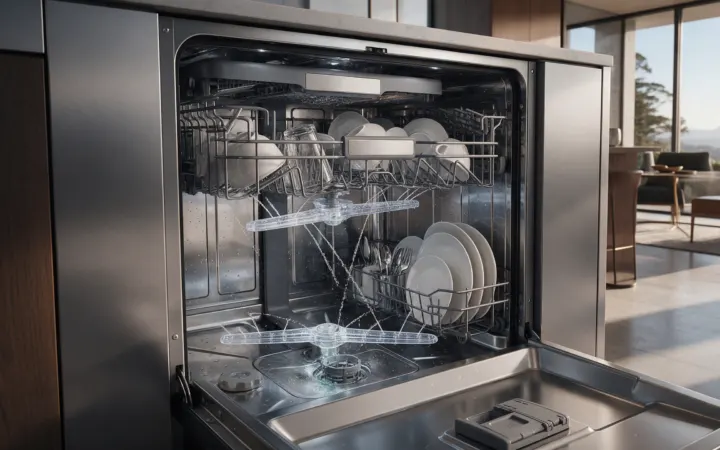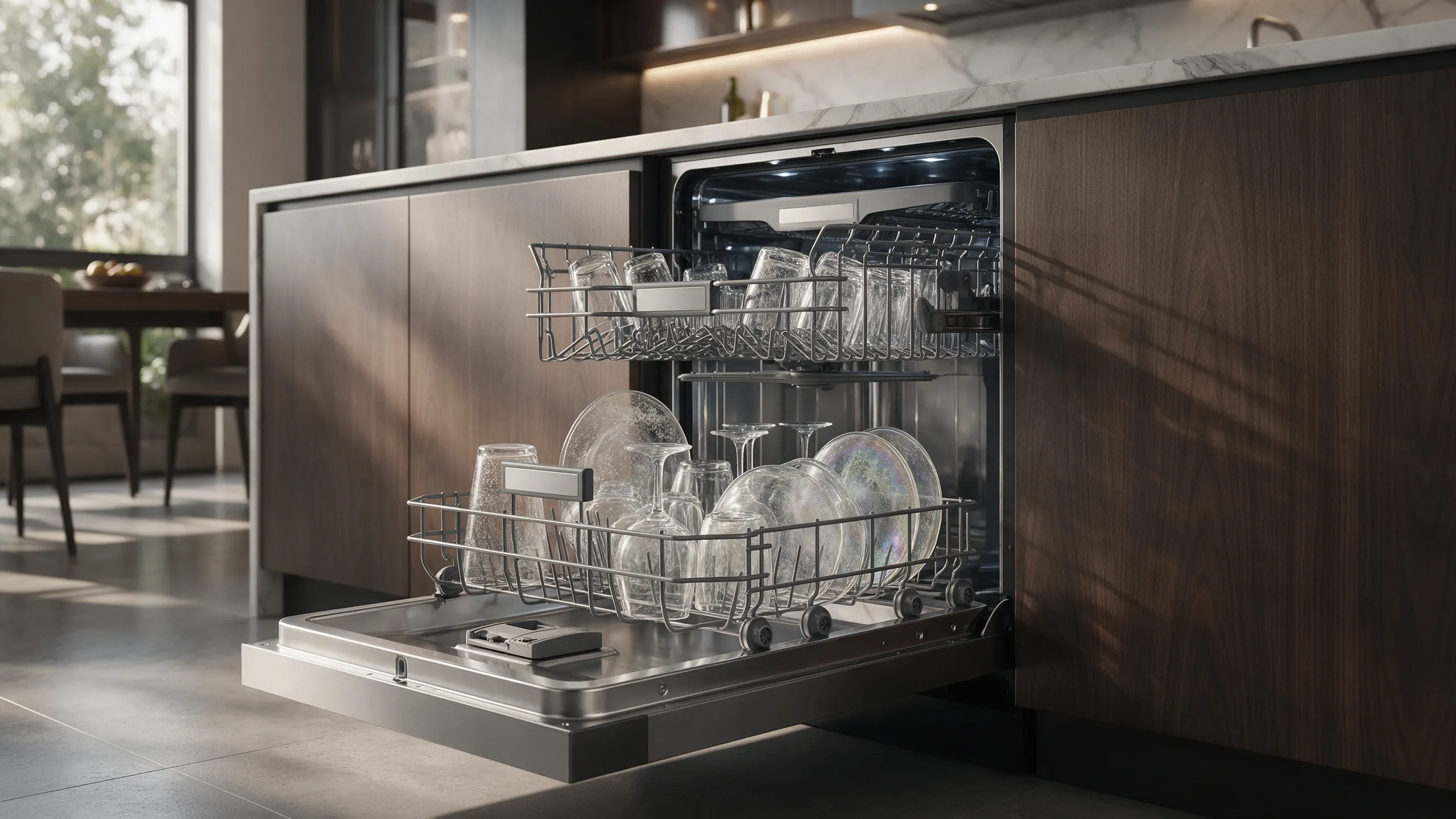
How Viking models dry the load
Drying differs from one Viking dishwasher to the next, so the first job is to find out which type you have. The VDWU724 7 Series lists OpenAir drying, which opens the door automatically at the end of the cycle, and Turbo Fan Dry, which circulates air for drying. If you run that model and the door never cracks open, or you close it again right away, the drying method is not being allowed to work. Models in the VDWU324 3 Series and VDWU524 5 Series lines are listed in the material with other features such as three-position upper racks and triple filtration, and drying depends on your own model’s use-and-care guide.
Plastic holds water far longer than glass or stainless steel. A load that is mostly plastic containers will come out wet in almost any dishwasher, so judge by what is wet before concluding anything.
Program and loading choices
The VDB325E Professional 325E offers Pots/Pans, Normal, Econo Wash, Light/China and Rinse/Hold programs and takes 15 international place settings. Programs that economise on water or heat can leave more water on dishes than the heavier ones. If you moved to Econo Wash recently, that may be the whole answer, and a change back would show the difference. Rinse/Hold is not a full wash and will leave things wet because it is not meant to finish them.
Look at the load too. Cups and bowls that face upward collect water in their bases. A dishwasher that is crowded gives water nowhere to drain from. Tilt cups and bowls downward, leave space between items, and keep tall pieces from blocking the wash arms.
Rinse aid and detergent also play a part in how water sheets off dishes, though the source material we have for Viking does not give a recommended product. Note what you use and whether the problem started when it changed, because that detail narrows things down quickly when you speak to a technician.
When a code explains it
If a code is on the display, read it before changing anything else. The 3-2 code is a pump flow error: insufficient or inconsistent water flow through the wash system, and the flow-through heater is not allowed to activate. A heater that cannot run will leave a load warm and wet, not hot and dry. The 2-2 fill error is another candidate: the pressure sensor does not reach the target fill pressure during a fill, and on models without a pressure sensor the control reports insufficient temperature change. A short fill means a cooler, weaker cycle. Our F4 water intake fault page describes a similar problem in a different Viking code format.
Loading and program tests to run first
- Run a normal program with a mixed, evenly spaced load and note whether the glass and metal are dry and the plastic is not.
- If your model opens the door after the cycle, let it do so and give it time before unloading.
- Check the display for a code after the cycle. Write it down exactly.
- Confirm the incoming hot water is reaching the dishwasher by running the kitchen tap hot before starting, if your manual allows it.
- Clean the filter so that wash water can flow, using the guide for your model.
Avoid using the machine with the door propped open while it runs.
What heat-and-flow checks cannot confirm for drying
They cannot show whether the heating element or flow-through heater works, whether the fan in a Turbo Fan Dry system turns, or whether the door mechanism responds on schedule. A load that is wet only in the lower rack points one way; a load wet everywhere points another. These are the kinds of tests a technician runs with the unit in test mode.
How a technician tests drying on a Viking dishwasher
A technician checks the displayed code, the water fill and temperature, the heater and fan, the door release on models that have OpenAir, and the pump flow. Read more at Viking dishwasher repair and the dishwasher reference.
What to give us when dishes stay wet
Provide the model and serial number from the label, the program you use, which items are wet, any code you saw, and when it began. If a recent move to a different detergent or rinse product coincided with it, say so.
Frequently asked questions
Why does my Viking dishwasher leave plastic wet but not glass?
Plastic holds water and releases heat quickly, so it dries slowly in any dishwasher. That pattern alone is not a fault.
Should the door open on its own at the end of the cycle?
On a VDWU724 with OpenAir drying, yes, the door opens automatically at the end of the cycle. Other models do not list that feature.
Does code 3-2 mean the dishwasher cannot dry?
It means the control found weak water flow and does not allow the flow-through heater to activate, which can leave dishes wet. A technician should test the flow.
Technical sources
- Viking 451 Series Built-In Dishwasher Use & Care Manual F20879C: https://www.vikingrange.com/MEDIA_CustomProductCatalog/m6004836_F20879C_EN_451_Series_Built-In_Dishwashers.pdf
- Viking dishwasher Use & Care Manual F20859: https://www.vikingrange.com/MEDIA_CustomProductCatalog/m4510042_F20859.pdf