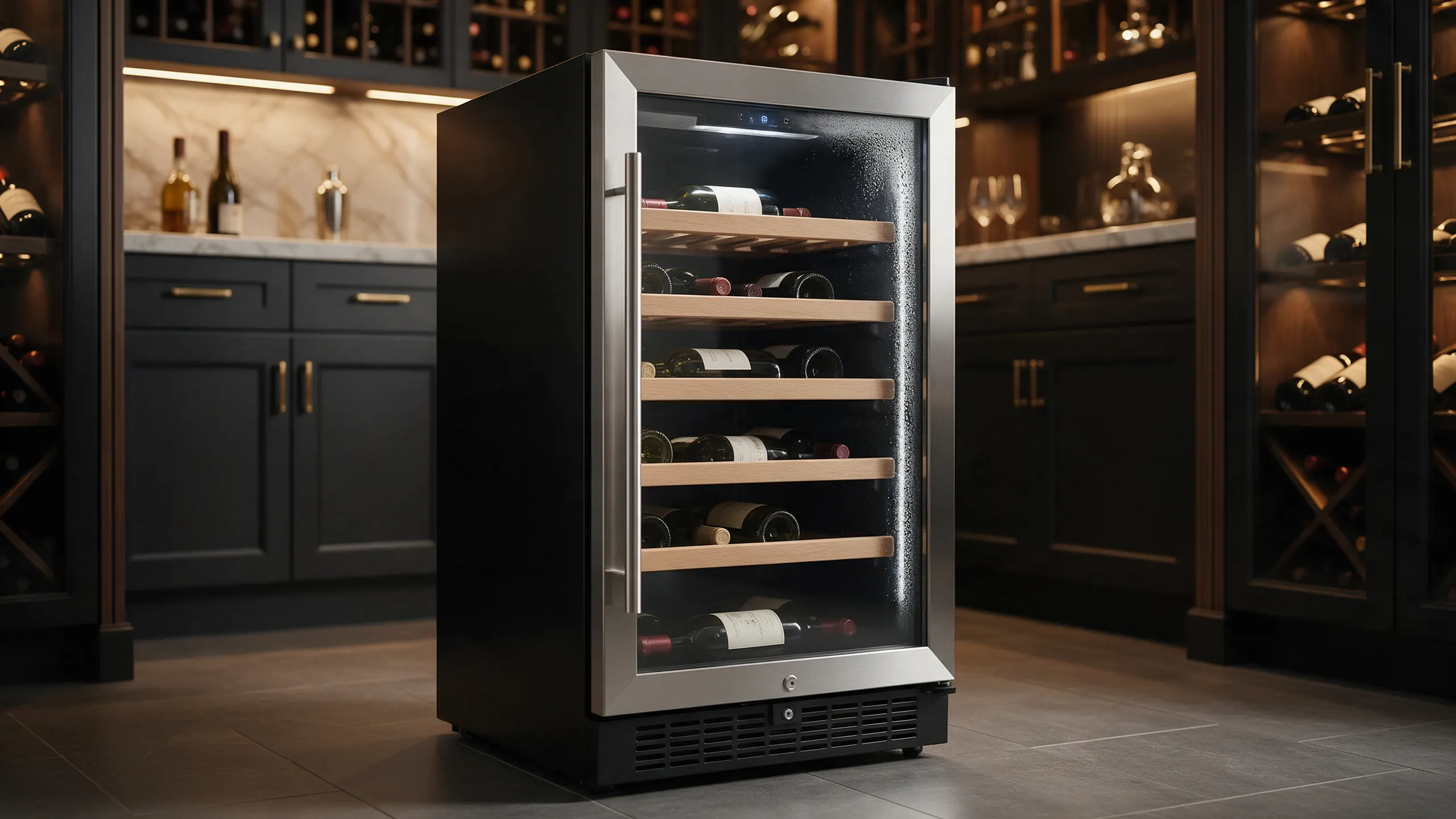
Moisture on or inside a Viking wine cellar usually comes from warm, humid room air getting in, either through a door seal that is not sealing or from the door being opened often. Look at the door seal, the room conditions and the temperature setting before assuming the cooling system is at fault.
Outside the glass or inside: which is it?
The location of the condensation is the first clue. Moisture on the outside of the door glass means the glass surface is colder than the room’s dew point, which happens in a humid room or beside a cold setting. Moisture on the inside means humid air has entered the cabinet and cooled, which points to the seal, frequent opening or a loading problem. Wipe a spot dry and watch how fast it returns, and make a note of the time of day.
The door is built to resist heat gain. The integrated FDWCIC7240 has UV-protective triple-pane bronzed glass, so a lot of condensation on the outside of the glass in a normally humid room is not automatically a fault. What matters is whether it is new, heavy or accompanied by drips.
How the door seal lets humid air in
Close the door on a strip of paper at several points around the frame. If the paper pulls out without any resistance in one place, the seal is not gripping there. Look for folds, flattened corners, dried or cracked rubber, and crumbs or sticky residue on the gasket. Clean the gasket with mild soap and warm water, dry it, and retest. A cabinet that is not level or a door that sags slightly can also open a gap, and this one is a cheap check with a level.
The unit is a narrow built-in, with an overall width listed as 23 7/8 inches. A tight built-in space with little clearance can leave the door rubbing on adjacent cabinetry or pressing unevenly, so look at how the door sits in the opening.
Two temperature zones and the setting you chose
Wine storage is split in this model into two temperature zones, with adjustment spanning 39 to 64 degrees F. A setting at the cold end of that range, in a warm and humid room, makes the glass and interior surfaces sweat more than a setting in the middle. If you are storing both whites and reds, check that you have not set the cold zone lower than you need.
Change a setting by a small step and give the cabinet a day to settle before judging. Repeated adjustments make it harder to see what is helping.
Humid weather, a kitchen with a boiling pot or dishwasher venting nearby, and a door that is often open all raise the moisture that gets in. Every time the door opens, humid room air replaces cold air and condenses on the cool surfaces. Do not pack bottles against the back wall or the glass, since blocked airflow makes cold spots. Leave space as the manual shows.
What owner checks cannot decide
You can clean the gasket, check level and fit, adjust a setting and watch the pattern. You cannot tell whether condensation inside means a failing seal, a faulty drain path or a cooling system running colder than its setting. If water pools on the floor of the cabinet or drips out of the unit, or if the condensation does not respond to any of these changes, the cause is beyond a quick check.
How a technician looks into condensation
A technician measures cabinet temperatures in each zone, tests the seal, looks at drainage and defrost behavior, and checks the sensors and control. Read about our Viking wine cellar repair and the wine cellars reference for more.
A two-day log that separates seal from setting
Keep a simple record for two days. Write the room’s feel (humid, dry, cooking in progress), the zone settings, how often the cellar was opened, and where the moisture appeared. If the Viking wine cellar sweats mostly on cooking days and clears on dry ones, the room is the main driver and the cabinet is probably fine. If it sweats equally on every day, including with the door closed all night, suspect the gasket, the fit or the cooling behavior.
Take a photo of the moisture each time with a ruler or coin beside it for scale. A before-and-after photo around a gasket cleaning is the clearest proof for a technician that the cleaning made no difference to your Viking unit.
What to have to hand when you call
Give us the model and serial from the label, whether the moisture is inside or outside, the zone settings, the room conditions, how long it has been going on and what you tried with the gasket.
Frequently asked questions
Is condensation on a Viking wine cellar door normal?
A little on the outside of the glass in a humid room can be. Heavy, new or interior condensation deserves a look at the seal and settings.
Can the temperature setting cause condensation?
Yes. A very cold setting in a humid room makes surfaces sweat more, so try a milder setting in small steps.
How do I know the gasket is bad?
If a paper strip slides out easily in a spot, or the gasket is torn, flattened or hardened, it is not sealing and needs service.
Technical sources
- Viking refrigeration documentation archive: https://vikingrange.com/support-and-documentation/product-documentation/filter/category/chill_viking
- Viking refrigerator Use & Care Manual F20394: https://www.vikingrange.com/MEDIA_CustomProductCatalog/m4570043_F20394_EN.pdf